Construction Change Directive
Notice Kahua is a very flexible and customizable platform. In your domain, this application may have been modified to meet your company's needs. The online help uses default field labels for field names and describes standard workflows. Please check with your domain administrator for specific information about working in your organization's domain.
The Construction Change Directive (CCD) app is used to document and communicate a directive to proceed with a change to the project. It captures the scope of work, contract and party information, and any cost and schedule impacts. Supporting contract documents and reviewer approvals can be managed directly from the record.
Key elements of the app include the following:
-
You can use the Process function to copy information from a construction change directive into a new record in the Expense Change Orders or Issues app.
-
If configured appropriately, you can submit the Construction Change Directive for review. It is sent as a task to the user designated in the approval configuration.
How to . . .
 Create a construction change directive
To create a new construction change directive, complete the following steps:
-
Review the header to ensure that you are in the correct project or partition.
-
Navigate to the Construction Change Directive application (Apps > Document Management > Construction Change Directive).
-
Click New in the action bar.
-
Complete the following fields as appropriate:
Note Depending on how this app is configured for your domain, there may be fields or sections listed here that do not appear for you, fields and sections that appear for you which are not listed here, or fields and sections which appear in a different order. If you have any questions, check with your domain administrator.
Field Description Details Number Allow Kahua to auto-number the record, or enter a different value.
Note The number format can be configured by your domain administrator. Refer to Number.
Date By default, today’s date appears. Modify if appropriate. Subject Enter a subject for the change directive. Workflow Status Displays the current workflow status of the record (for example, Open). Category Status Select the appropriate category/status value for your project’s process.
Note This lookup list is managed in the Configuration app. Refer to Lookups.
Expense Contract Select the expense contract associated with this directive, if applicable. Funding Contract Select the funding contract associated with this directive, if applicable. Owner (Local) Select the owner contact/company for this directive. Architect (Local) Select the architect contact/company for this directive. Contractor Select the contractor responsible for executing the directive. Distribution Select contacts to receive the directive and related notifications, as appropriate. Action Requested Indicate the action being requested by this directive.
Note This lookup list is managed in the Configuration app. Refer to Lookups.
Reason Select or enter the reason the change directive is being issued.
Note This lookup list is managed in the Configuration app. Refer to Lookups.
Scope of Work Describe the work being directed, including any relevant clarifications.
Disclaimer Enter any required disclaimer text for your organization’s process, if applicable.
CSI Code Select the appropriate CSI Code, if used in your project.
Location Select one or more locations, as appropriate.
For more information on setting up location values, refer to Setting up locations.
Cost Cost Effect Indicate whether this directive is expected to increase, decrease, or have no cost impact
Note This lookup list is managed in the Configuration app. Refer to Lookups.
Cost Type Select the cost type to categorize the anticipated impact.
Note This lookup list is managed in the Configuration app. Refer to Lookups.
Schedule Time Effect Indicate whether this directive is expected to affect schedule.
Note This lookup list is managed in the Configuration app. Refer to Lookups.
Time Estimate (days) Enter the estimated number of days of schedule impact, if applicable.
Contract Documents Drawing Number / Detail Number / Spec Section Enter the relevant information as appropriate.
Other Enter any other contract document reference information, as needed.
Reviewers Reviewer information appears here.
Note To use the review workflow, the Use Review Workflow setting must be enabled on the Settings tab in configuration and the approval must be configured in Configuration > Approvals. Refer to Approval configuration.
Comments Enter any comments as appropriate.
Comments are recorded with the author name, and date and time the comment was saved. Comments from other users appear here.
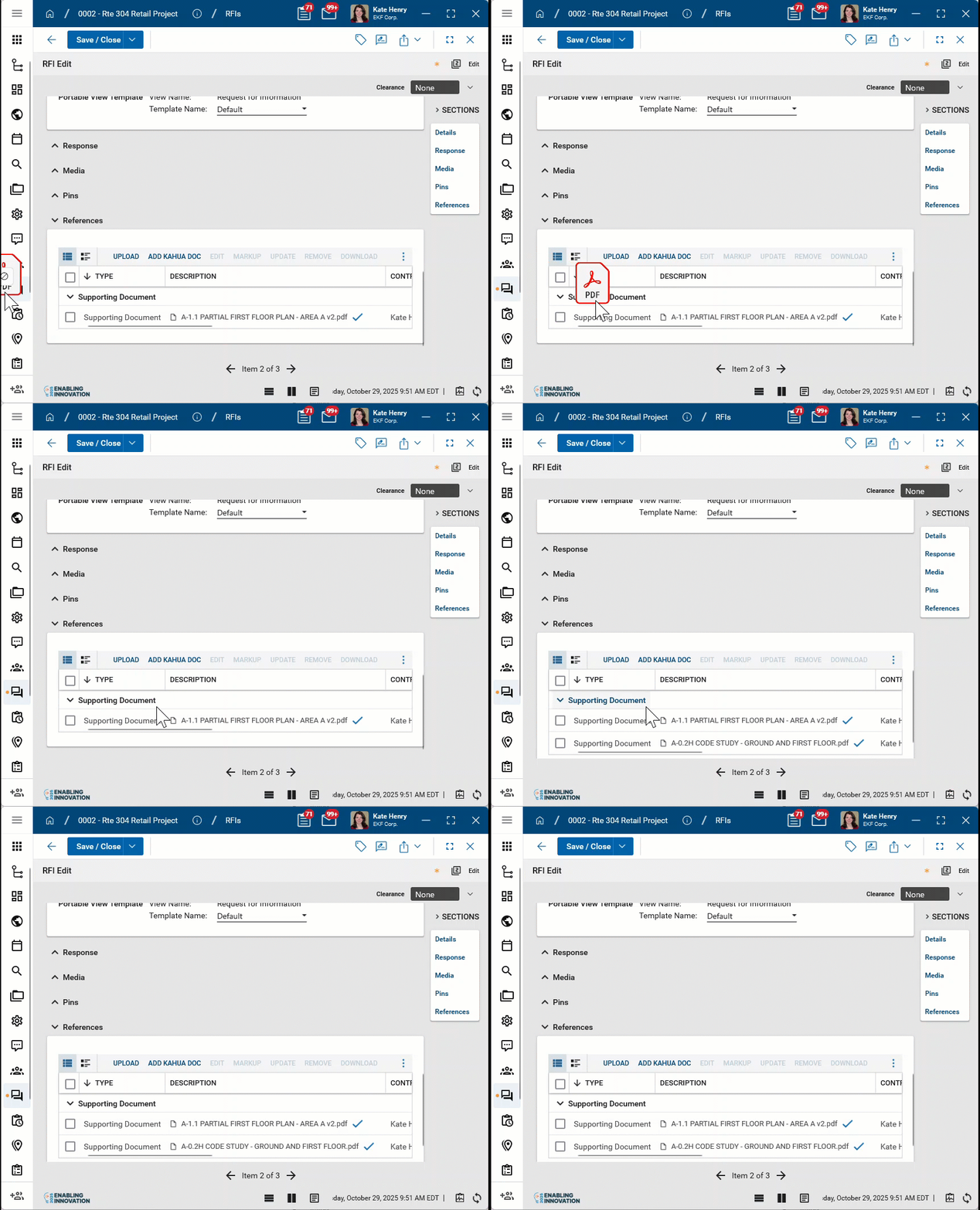
References Upload or select any relevant files or documents. You can use drag and drop to add a file to this section. For more information on using this section, refer to References section.
-
Click Save when you are done.
-
Click Close & Lock to prevent further edits, if your process requires locking after issue.
Submit for review
Note To use the review workflow, the appropriate settings must be enabled on the Settings tab in configuration and the approval must be configured in Configuration > Approvals. Refer to Settings tab and Approval configuration.
If configured appropriately, you can submit the Construction Change Directive for review. It is sent as a task to the user designated in the approval configuration.
To do so, complete the following steps:
-
Review the header to ensure that you are in the correct project or partition.
-
Navigate to the Construction Change Directive application (Apps > Document Management > Construction Change Directive).
-
Select the appropriate record from the log view and click on it to open the detail view. Select Submit for Review from the action bar. You may need to click the More icon
 to access the appropriate action.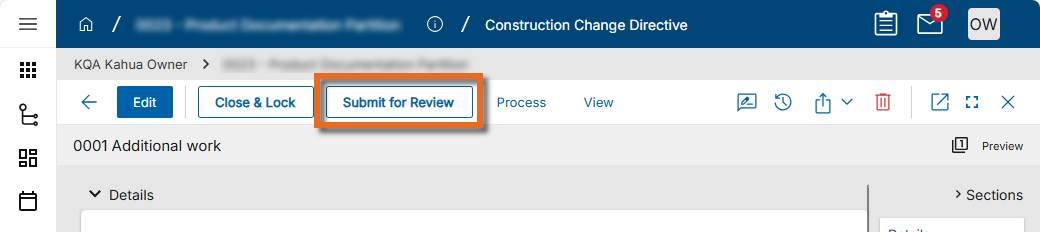
-
The request for review is sent as a task to the appropriate user and fields in the Reviewers section are updated.
Create an approval document
Your project may be configured to require an approval document as part of the approval workflow for records in this app. An approval document is created in the References section of a record. To create an approval document, select Add Approval Doc, name the document, and select the appropriate supporting files. These files are then combined into a single PDF that can become part of the approval workflow.
For more detailed information creating an approval document, refer to Create an approval document.
For information on setting up approvals, refer to Approval configuration.
Process a CCD record into a record in another app
You may want to track information from a Construction Cost Directive as a change request, change order, or an issue. You can use the Process function to copy information from the CCD record into a new record in those apps.
To copy information from the original record into a new record in another app, complete the following steps:
-
Review the header to ensure that you are in the correct project or partition.
-
Navigate to the Construction Change Directive application (Apps > Document Management > Construction Change Directive).
-
Right-click on the item and select Process, or open the detail view and select Process from the action bar.
-
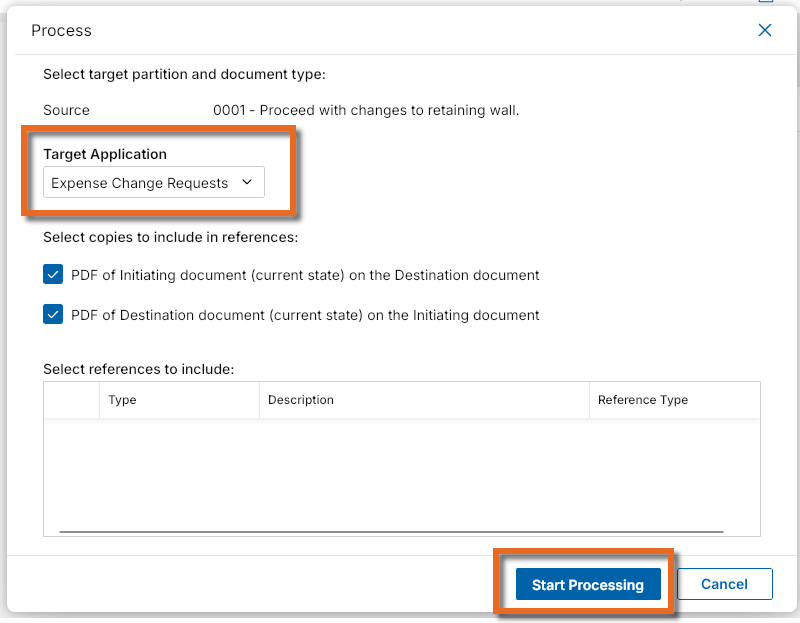
In the Target Application field, select the appropriate app. By default, reference files are included. Clear the check boxes for any files you do not want to include.
-
Click Start Processing.
-
The target application opens to a new record with information from the CCD. Complete any additional fields and click Save.
Generate a log report or other reports
You can generate a report from a selected log view, or use one of the built-in reports available by default in each application. For more information on creating your own reports, including how to set up scheduled reports, refer to Creating ad hoc reports.
Note For information on modifying the logo that appears on reports in your project, refer to Managing report logos.
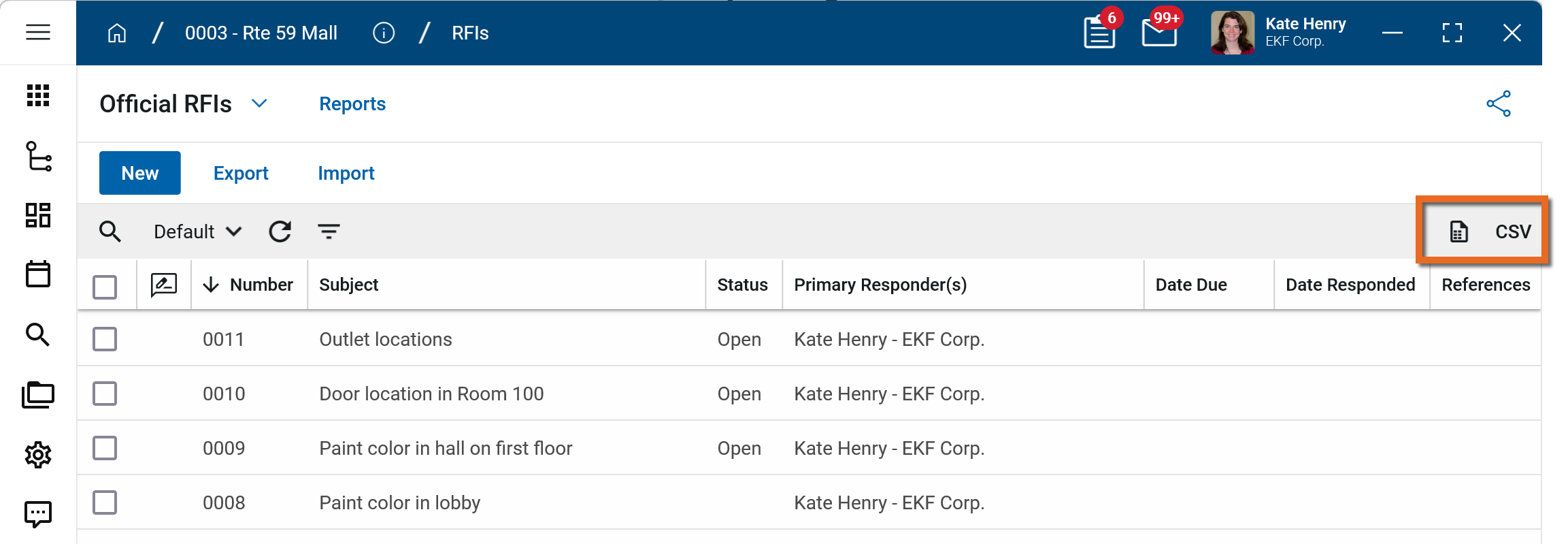
To generate a report from a log view with up to 10,000 records, click the More icon  and select Print. If your log view contains more than 10,000 records, the Print option will be disabled and you can select
  to download the records to a CSV file instead.
To generate an application report, complete the following steps:
-
Navigate to the application.
-
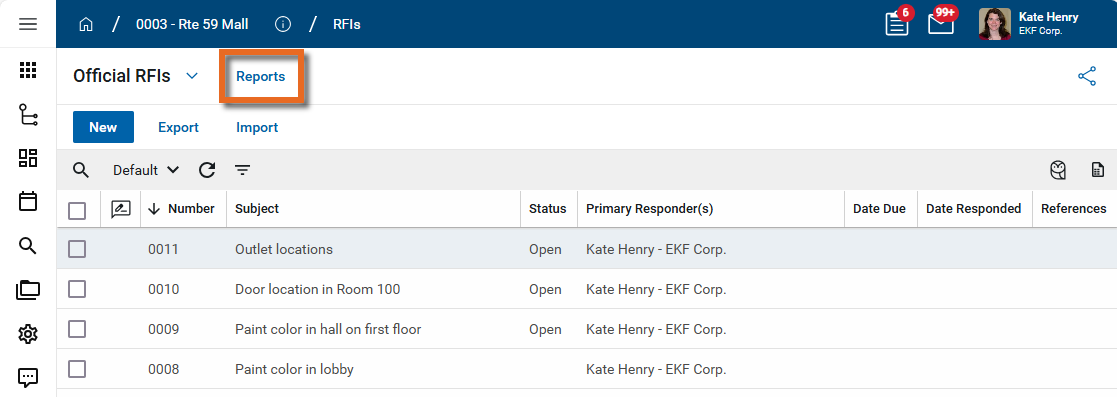
Select Reports in the application title bar.
-
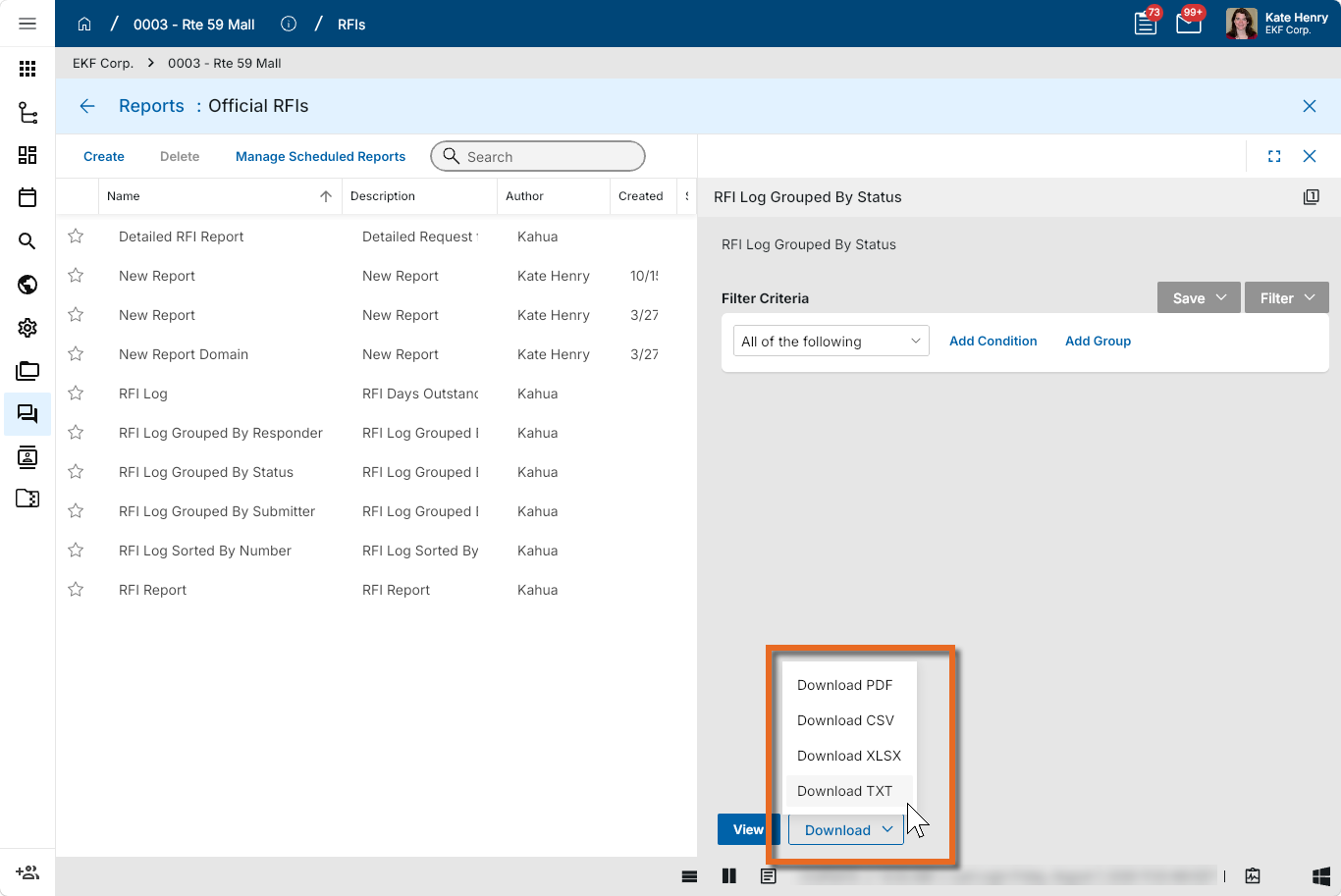
Select the report you want to run.
-
Apply any desired filters.
-
Select View or Download as appropriate. For more information, refer to Viewing Reports.
-
Click the Close icon
 when you are done.
Perform standard actions on a single record (print, send, view history, delete, etc.)
From the detail view of a record, there are several standard actions you can take. Depending on your permissions, some or all of the following options may be available to you:
-
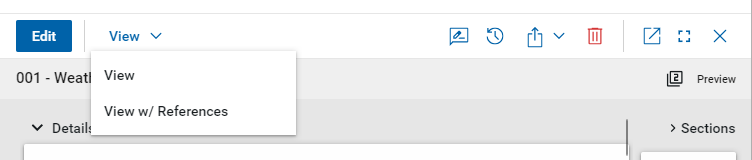
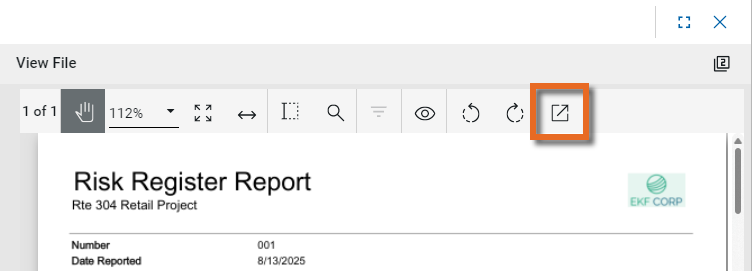
View and View w/References - Select View or View w/References to open a PDF view of the current record. The PDF file can be printed or shared from the viewer by clicking on the Open PDF icon
 .
.
Note Only references where the Include on Send value is set to "Yes" are included in the View w/References.
Additionally, if Include Markup on Send is set to "Yes", any markups on the file are included. -
Discussions
 - Select this icon to open the Discussions panel. If enabled in your domain, the discussions feature allows you to participate in public or private conversations associated with specific records. For more information, refer to Discussions.
 -
View History
 - Select this icon to open the History page for the record. The history page provides details regarding all activity (creation, edits, saves, etc.) performed on the record. Click view edit to drill down into more detail on a specific action. Click hide edit to close the action detail. Click the Close icon
  to close the history page.
 -
Send actions
 - Click this icon to select an appropriate Send action for the record. The following options may be available to you:
-
Copy Link and Copy Portable View Link - Select this option to copy a URL link for the record or record's portable view to your clipboard. This link can be sent outside of Kahua. Users with the appropriate permissions will be able to open Kahua directly to that record or portable view by using the link.
-
Copy QR Code and Copy Portable View QR Code - Select this option to generate a QR code for the currently open record or record's portable view. The QR code can be shared directly from your screen, or copied to your clipboard to be shared as appropriate. This QR code can be shared outside of Kahua. Users with the appropriate permissions will be able to open Kahua directly to that record or portable view by using the link.
-
Send - Select this option to open a new Kahua message with the open record included as an attachment. References with the Include on Send value set to "Yes" are also included. For more information, refer to Messages app.
-
-
Delete
 - Select this option to delete the open record. You must agree to the confirmation message before the record is deleted.
Alternatively, right-click on the record in the log view and select Delete, or select multiple records from the log view and select Delete.
Note If a record is deleted in error, your domain administrator may be able to recover it through the Recycle Bin app. For more information, refer to Using the Recycle Bin.
-
Open in a new window
 - Select this option to open the current record as read-only in a new window (desktop host) or browser tab (web host). This allows you to navigate to other records in the original Kahua instance while keeping the read-only window or tab open for reference. To re-open the record on the read-only window or tab in Kahua, select Open in the header.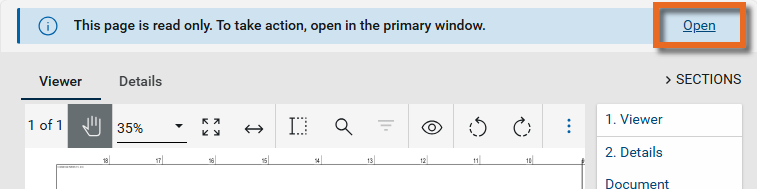
-
Maximize
 and Minimize
  - Select Maximize to open the record to a full screen view. From the full screen view, select Minimize
  to return to the original view.
 -
Close
- Select the close icon to close the currently open item.
Configure the app
Your domain administrator or another user with the appropriate permissions can configure the app in the Configuration application.
Important When working in the Configuration app, it is important to review the header and ensure that you are working at the correct level in the hierarchy, either the root domain or at a partition or project level.
Settings that you establish at the root domain or lower levels will inherit down the hierarchy until they are overridden. For more information on the hierarchical structure of Kahua, refer to Understanding the hierarchical structure of Kahua.
The Configuration app can be accessed directly through the apps list (Apps > Administration > Configuration), or, in some applications, by right-clicking on an application in the launch bar and selecting Configure. When you select Configure for an app from the launch bar, the detail view of the configuration page for that application opens automatically.
For general information about the Configuration app, including how to set up an approval workflow, refer to Configuration app.
For general information on configuring this app in Configuration, refer to Application configuration.
The following items are part of the application configuration and are specific to this application:
| Options | Description |
|---|---|
| Settings tab | |
| Use Review Workflow |
Select this option to make the Review workflow available. Note You must also configure the Review approval in Configuration > Approvals. Refer to Approval configuration. |
| Use Manual Status Override |
Select this option to allow users with the appropriate permissions to use workflow action buttons to increment status of a record (to Pending, Approved, etc.). This option is typically used when workflow is not enabled. |